ARCHITECTURAL UPGRADES IN CURA 5.13
Cura 5.13 introduces dedicated hardware orchestration for the Factor 4 Plus industrial platform, accompanied by refined perimeter acceleration management and expanded local mesh modifier parameters.
Release Synopsis & Parameter Scope
- Hardware Target: Native kinematic mapping and dual-core printhead parameters for the industrial UltiMaker Factor 4 Plus system.
- Thermal Sequencing: Autonomous active chamber heating synchronization alongside calibrated standby temperature ramp profiles.
- Perimeter Dynamics: Adaptive jerk limits calibrated to decouple external wall velocity from rapid interior infill accelerations.
- Hierarchy Precision: Isolated sub-mesh modifiers retain specific wall line counts without corrupting global perimeter rules.
SYSTEMIC SLICING PARAMETERS
Discover how the 5.13 update restructures project configuration files, local support boundaries, and material transitions for complex engineering components.
The integration of Factor 4 Plus definitions establishes dedicated firmware-level communication protocols within the Cura workspace. Printhead geometry definitions now account for high-torque dual extruders, preventing gantry collision zones during dual-material runs.
Slicers handle tool-changing differently when working with automated material stations. The 5.13 engine automates retract-before-purge sequences based on the exact thermal envelope of engineering polymers like PPS-CF and UltiMaker Tough PLA.
- Calibrated purge volumes customized for composite-to-soluble transitions.
- Firmware acceleration handoff preventing overshoot on high-mass toolheads.
- Active chamber temperature commands embedded directly into starting G-code routines.
Previous engine iterations locked external shell acceleration to the overall wall profile unless overridden manually through script plugins. Cura 5.13 exposes explicit perimeter acceleration and deceleration ramps within the primary motion configuration tab.
High-speed outer perimeters frequently induce ringing artifacts along cantilever corners. Slicing with decoupled corner jerk settings preserves pristine exterior finishes while inner perimeters and infill structures deposit at peak volumetric thresholds.
- Isolated outer wall acceleration thresholds to suppress high-speed resonance marks.
- Independent corner deceleration curves ensuring consistent extrusion line widths.
Industrial dual extrusion requires careful thermal choreography between active and passive nozzles. When alternating between core materials and support interfaces, idling nozzles risk filament baking or severe oozing across the active build area.
The updated thermal staging algorithm dynamically predicts nozzle transit times. It initiates nozzle reheating precisely in advance of the tool exchange layer, eliminating idle wait dwell times while maintaining nozzle hygiene.
- Predictive pre-heating timers adapted to extruder thermal mass and heater wattage.
- Standby temperature drop mitigation preventing thermal degradation of nylon matrices.
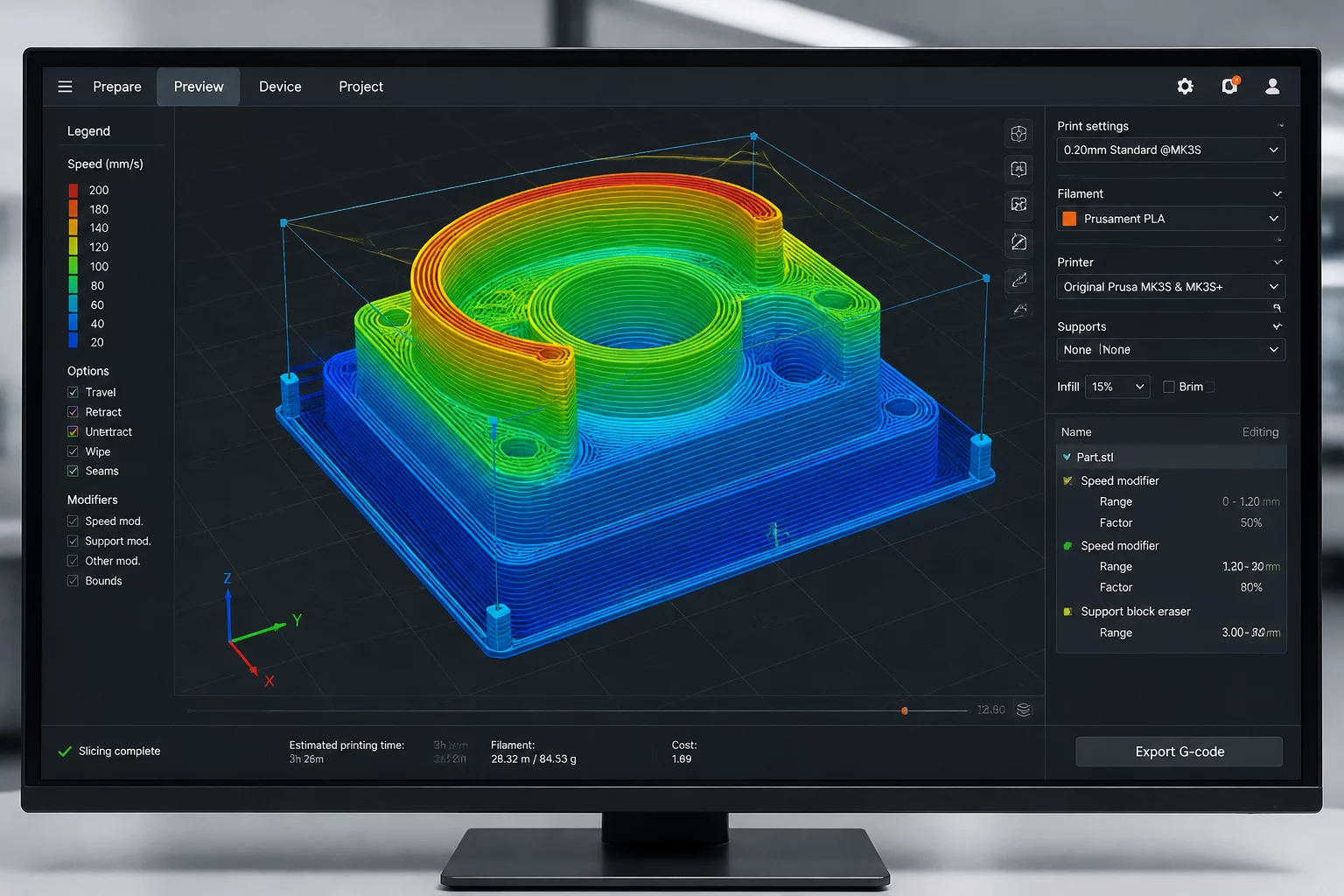
Cura 5.13 refactors the engine memory allocation for per-model and modifier volume evaluations. Local modifications applied through helper volumes or support blockers no longer force re-slicing of entire untouched plate components.
Engineers working with dense mechanical assemblies can now specify localized infill densities and custom wall thickness rules without disturbing global layer settings.
- Zero inheritance bleed from modifier boxes to neighboring independent parts.
- Accelerated slice calculation caches for repeated local adjustments on complex geometry.