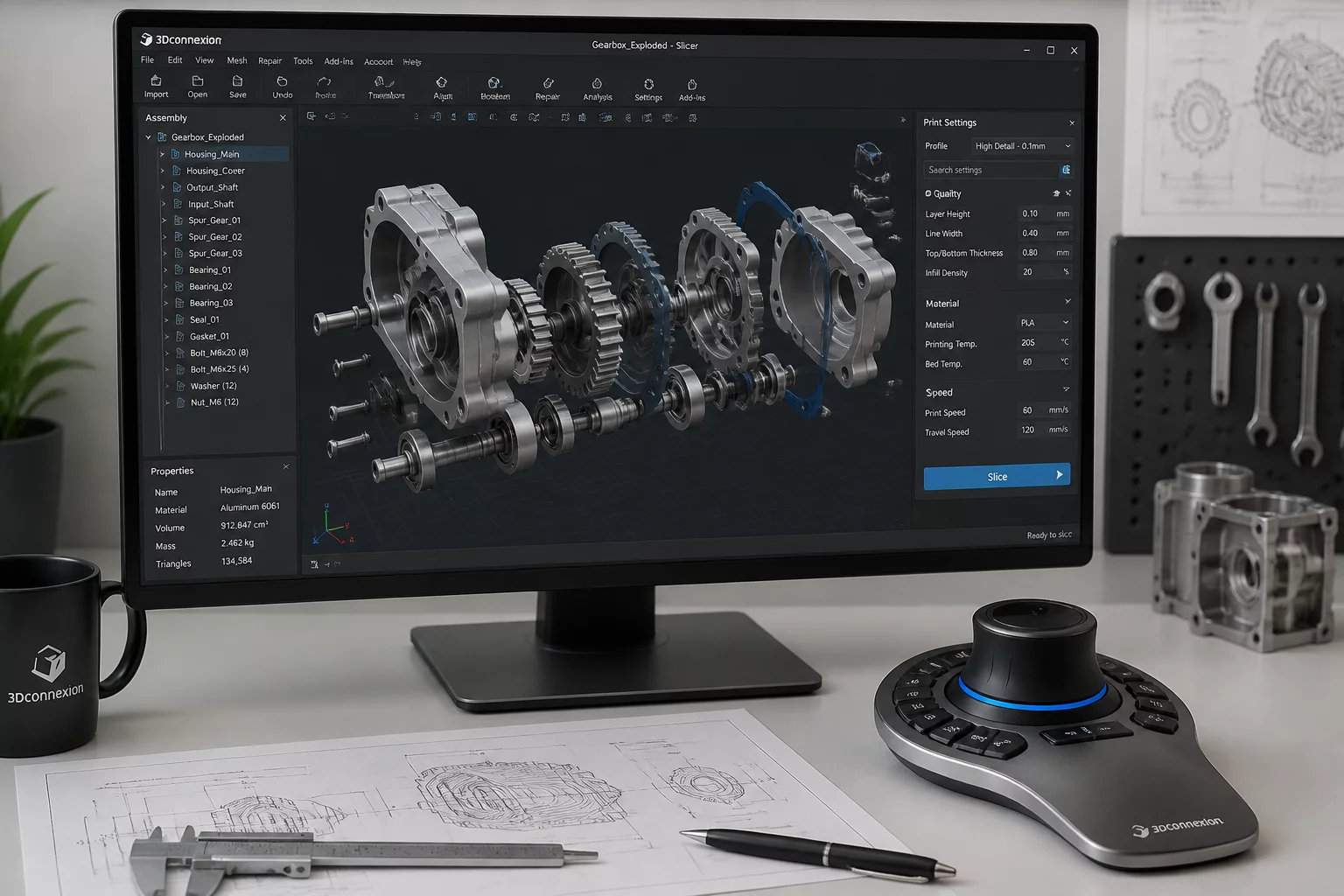
Engineering Precision In Viewport Operations
Bambu Studio version 2.8.0.50 Beta shifts the slicing experience beyond standard path compilation into a full-fledged additive assembly workshop. By bridging physical 6DoF hardware controllers with interactive 3D exploded construction steps, the software addresses critical workflow bottlenecks in multi-part engineering builds.
Key Functional Highlights of Version 2.8.0.50
- 3Dconnexion SpaceMouse Pro Integration: Direct driver hooks allow six-degree-of-freedom pan, continuous tilt, and orbital navigation without interrupting mesh editing or toolpath selections.
- Embedded 3D Assembly Manuals: Multi-part 3MF project packages now store sequential exploded animations, bill of materials tables, and fastener callouts natively.
- Strict Hierarchy Isolation: Local object and sub-part modifier adjustments are strictly compartmentalized, preventing accidental pollution of global filament presets.
- Flow Preview Enhancement: Volumetric speed and extrusion rate visualizations now feature micro-gradient shading across dense perimeter interfaces.
Deep Analysis Of Beta Capabilities
Examine how driver-level hardware handling, structured 3MF container extensions, and parameter scoping rules perform in real-world engineering environments.
Navigating densely populated build plates with traditional two-button mice and scroll wheels often breaks user focus. Each orbit or zoom command requires switching cursor modes, interrupting modifier placement and face-painting workflows. Version 2.8.0.50 Beta establishes low-latency driver connections directly to 3Dconnexion 3D mice, granting six degrees of freedom simultaneously.
Engineers can fluidly glide through complex internal cavities, rotate overhang clusters for support verification, and adjust camera angles while keeping the cursor firmly placed over precise modifier settings or brush tools.
- Individual sensitivity and inversion curves for translation (X/Y/Z) and rotation (pitch/roll/yaw) axes.
- Hardware button bindings for instant projection switching between Top, Bottom, Section Plane, and Isometric perspectives.
- Cursor preservation mode allowing simultaneous viewport rotation during active layer-by-layer slider scrubbing.
Traditionally, exporting a finished multi-part 3D print meant packaging loose STL files alongside static external PDF documents or third-party web manuals. Bambu Studio 2.8.0.50 introduces an embedded assembly manual authoring suite that stores step sequences directly in the project file metadata.
Designers set construction milestones, define translation paths for exploded component diagrams, and attach standard hardware callouts to printed components. Downstream operators can step forward and backward through realistic 3D assembly animations inside the slicer interface.
- Integrated bill of materials linking printed parts to standard threaded inserts, fasteners, and ball bearings.
- Dynamic exploded trajectory keyframes allowing step-by-step clearance verification before actual manufacturing.
A recurring pitfall in previous versions was scope contamination: modifying wall counts or infill patterns on an individual part frequently risked unintended baseline changes to sibling components or global project profiles. This beta establishes a clear barrier between root presets and local exceptions.
The revised parameter stack explicitly marks overridden attributes with visual indicator tags. Modifying global layer height or base print speed seamlessly flows to standard geometry without overwriting local custom modifier volumes.
- Clear visual status indicators distinguishing between inherited global values and localized overrides.
- Targeted revert controls permitting one-click reset of individual sub-part attributes without wiping the entire object tree.
Bambu Studio V2.8.0.50 Beta specifically caters to mechanical product developers, robotics laboratories, and digital fabrication service bureaus managing multi-component assemblies. The combination of hardware-assisted viewport control and self-contained build instructions significantly curtails manual documentation overhead and post-print assembly confusion.
Hardware developers preparing production kits can now share fully contained project files that instruct workshop technicians on exact assembly sequences, bridging the gap between CAD engineering and physical realization.
- Robotics mechanisms featuring nested gearboxes, captured bearings, and multi-color indicator dials.
- Batch manufacturing of open-source hardware kits requiring standardized, self-guided assembly protocols.