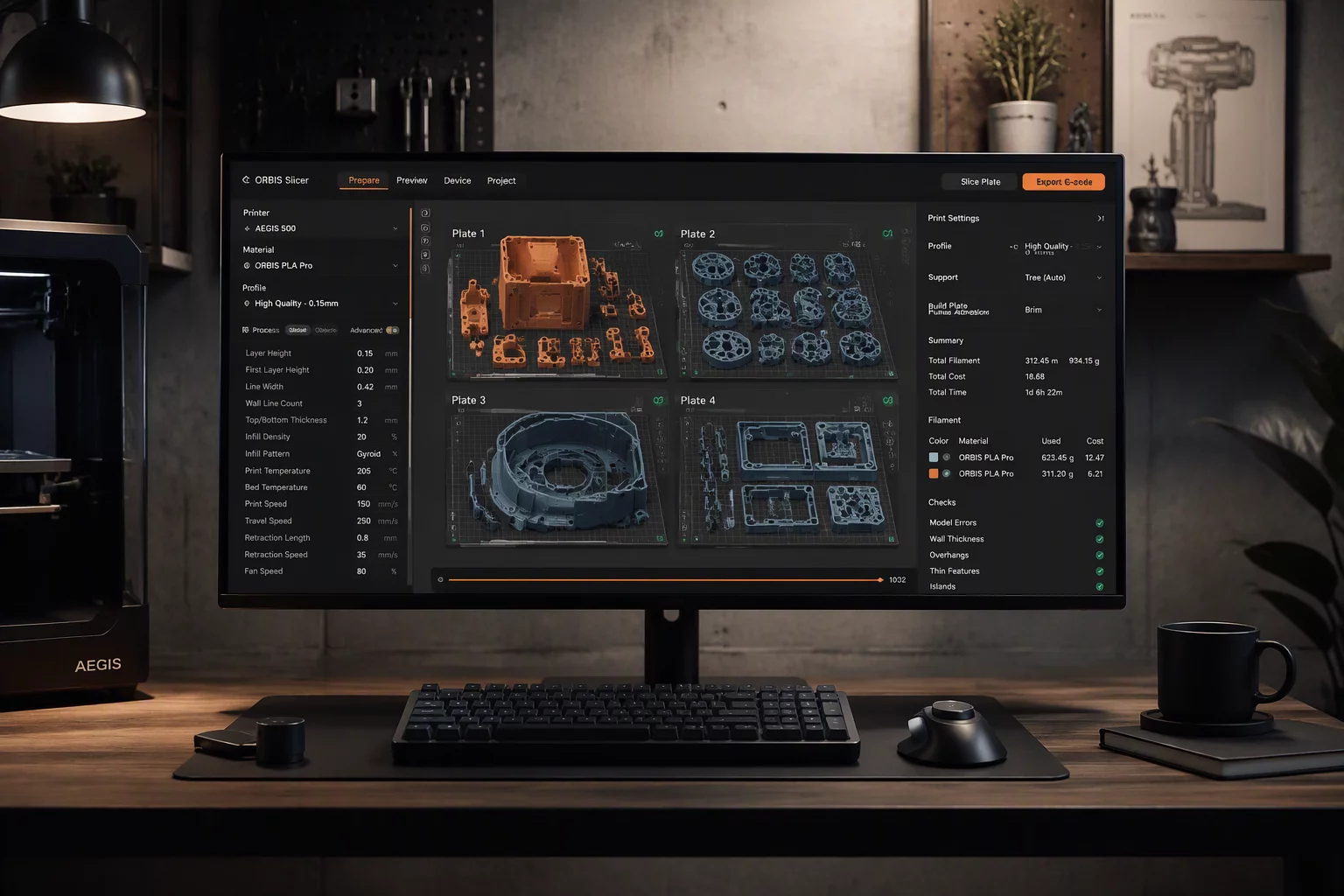
Modernized Workflow Architecture
PrusaSlicer 3.0 Public Preview transitions the long-standing slicing software from disconnected tab views into an integrated workspace. By consolidating print parameters, plate configuration, and object hierarchies beside a persistent 3D build volume, operators maintain situational awareness across complex multi-part manufacturing jobs.
Key Preview Architecture Highlights
- Contextual Parameter Dock: Slicing variables dock directly alongside the build volume with dynamic filters isolating local modifiers from master printer configurations.
- Multi-Plate Project Orchestration: Native multi-bed management enables autonomous print ordering, sequential clearances, and distinct plate bed temperatures within one single 3MF project.
- Procedural Scene Graph: Modifiers, support blockers, and enforcement meshes organize inside a reorderable hierarchy that displays inheritance origins in real time.
- Background Slicing Engine: Multi-threaded background recalculations eliminate viewport freeze when updating shell perimeters, variable layer heights, or seam placements.
Detailed Architectural Evaluation
Evaluating the operational enhancements introduced in version 3.0 highlights how modern desktop slicing platforms demarcate global baselines from localized geometric exceptions.
The historical separation across three isolated configuration tabs has been superseded by a persistent viewport layout. Operators inspect the active build envelope in real time while editing extrusion widths, infill angles, or cooling parameters.
The updated graphics engine introduces fluid vector overlays, responsive transform gizmos, and an indexed parameter search bar that accelerates access to expert-tier adjustments.
- Persistent 3D workspace eliminating disorienting screen transitions.
- Real-time search bar delivering direct keyboard navigation to nested variables.
- Calibrated high-contrast dark theme optimized for travel moves and retractions.
PrusaSlicer 3.0 eliminates ambiguity around parameter origins. When an operator assigns an override to a single component, the UI labels the setting with an inheritance badge to differentiate it from global defaults.
Restoring a customized parameter back to its parent preset requires a single click on the inheritance marker, leaving adjacent custom overrides fully intact.
- Visual indicator pips denoting global baseline, plate override, and part-level settings.
- Pre-export inspection audit displaying all active local overrides across the assembly.
Additive production runs routinely span across several consecutive plates. PrusaSlicer 3.0 introduces a comprehensive multi-bed architecture, enabling distinct process parameters, brim styles, and sequence modes per build plate.
Plates can be individually sliced, verified, and exported into machine jobs without requiring separate project files or duplicate asset imports.
- Autonomous boundary verification preventing toolhead collisions during sequential printing.
- Per-plate filament allocation allowing hybrid material setups in one project archive.
Modifiers, paint-on support regions, and surface texturing volumes now reside within an explicit procedural modifier stack. This hierarchical order guarantees reproducible boolean evaluations where volumes overlap.
Surface treatment tools such as top-surface ironing and localized fuzzy skin integrate into modifier boundaries, providing localized structural reinforcement alongside decorative finishes.
- Reorderable modifier tree defining precise evaluation order for overlapping geometries.
- Automated CAD multi-body import with direct designation of functional modifier volumes.