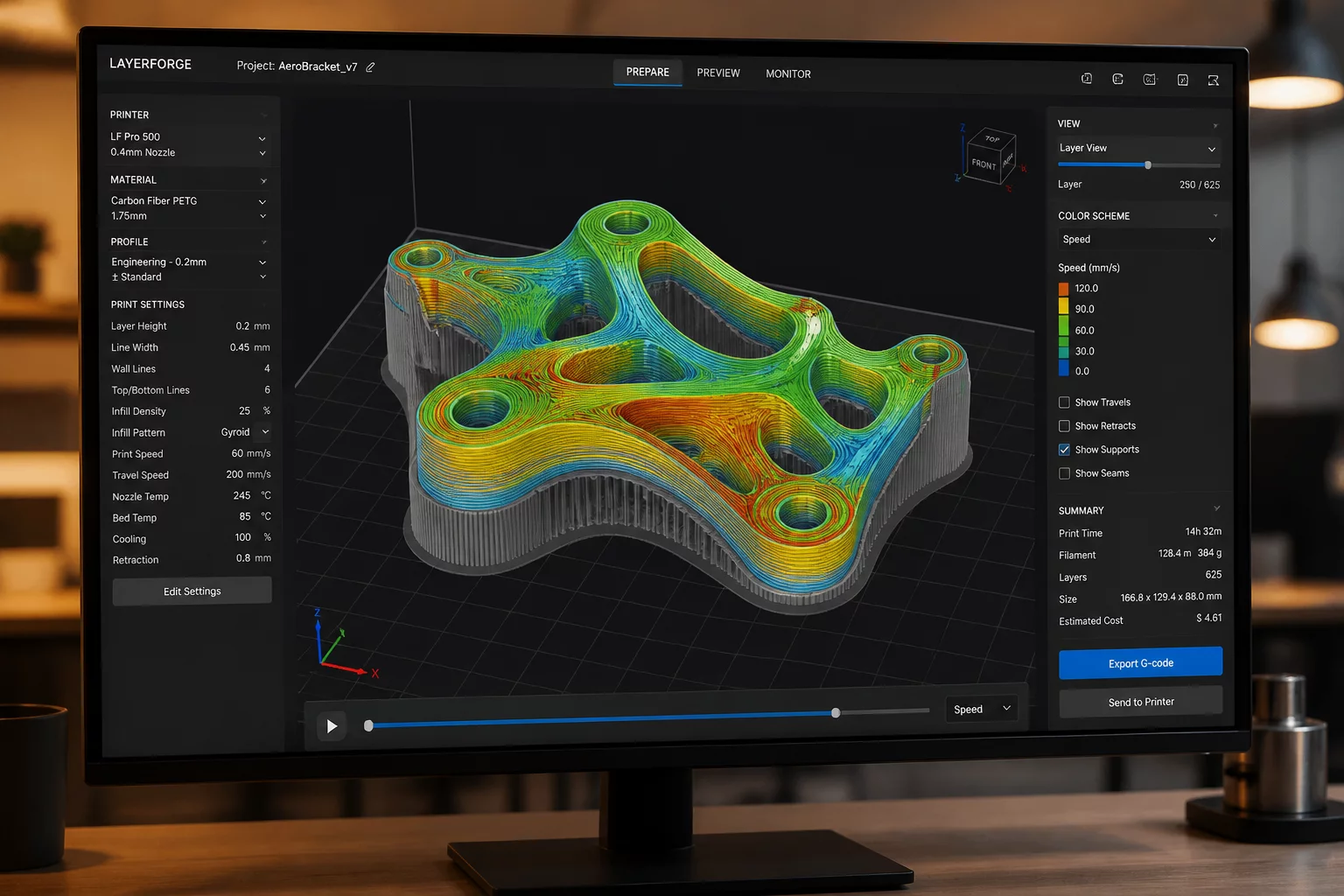
SYSTEMIC ADVANCEMENTS IN V2.4.0 ALPHA
OrcaSlicer version 2.4.0 Alpha marks a foundational evolution in open-source toolpath generation by pairing machine-level cloud telemetry with high-frequency spatial perimeter smoothing. The software resolves two persistent production dilemmas: multi-terminal preset divergence across distributed teams, and visible stair-stepping on low-angle spherical overhangs.
ARCHITECTURAL HIGHLIGHTS AT A GLANCE
- Orca Cloud Hub: Encrypted project storage and direct multi-printer dispatching that eliminates local network socket instability during simultaneous multi-bed runs.
- Z Anti-Aliasing Toolpaths: Micro-stepped variable extrusion widths deployed along sloped outer perimeters to diffuse planar layering without escalating print duration.
- Scoped Preset Synchronization: Clear decoupling between global machine boundaries, filament rheology presets, and project-specific modifier stacks across linked user accounts.
- Memory Optimization: A re-engineered geometry buffer reduces slicing overhead by up to thirty-five percent on dense triangular meshes with complex structural infill patterns.
OPERATIONAL MECHANISMS EXPLAINED
Examine how these changes alter the daily engineering pipeline, from the moment a CAD solid enters the plate viewport to real-time execution across local and remote printer nodes.
Orca Cloud transitions the slicing environment from a single-seat local utility into a connected manufacturing coordinator. While earlier branches relied strictly on direct IP addressing or proprietary manufacturer tunnels, version 2.4.0 Alpha establishes a lightweight, standardized remote dispatch layer. It allows developers and print technicians to beam validated 3MF project packages straight to connected nodes while safeguarding custom printer profiles against unwanted remote overwrites.
The system stores user-calibrated baseline settings in a secure cloud bucket without exposing network credentials to third-party tracking relays. Technicians operating multiple workstations can pull filament shrinkage coefficients and pressure advance baselines in seconds. This architecture prevents profile drift across secondary lab laptops, ensuring identical layer deposition regardless of who initiates the final G-code upload.
- Automated synchronization for material volumetric speeds and retraction parameters.
- Encrypted handshake protocol compatible with custom Klipper or OctoPrint gateways.
- Granular permissions that isolate project-level plate layouts from global hardware profiles.
Traditional FDM slicing generates visible topography terraces on shallow dome geometries because discrete layer heights force sharp step-offs between sequential slices. The Z anti-aliasing routine in OrcaSlicer V2.4.0 Alpha actively recalculates the volumetric flow rate along outermost perimeter arcs. By adjusting the nozzle offset and line width in fractions of a millimeter, the slicer produces a subtle rounded transition along sloped shells.
This optical and tactile smoothing operates entirely inside the kinematic limits of modern direct-drive extruders. Instead of penalizing print times through microscopic universal layer heights across the entire vertical volume, the anti-aliasing filter applies exclusively to detected low-angle slopes. As a result, engineering enclosures and ergonomic handheld components emerge with refined tactile ergonomics while overall manufacturing cycle times stay within normal thresholds.
- Intelligent slope detection restricting variable flow compensation to angles under 35 degrees.
- Eliminates abrupt mechanical resonances by maintaining continuous tangential perimeter paths.
The alpha release enforces stricter scope delineation between global workspace baselines, individual plate configs, and nested part modifiers. In previous iterations, altering an object-specific cooling threshold could inadvertently pollute the active machine preset. V2.4.0 Alpha introduces an explicit inheritance inspector in the left-hand panel, giving operators instantaneous clarity on which setting rules are inherited and which are overridden locally.
Whenever an operator designates an object for extreme tensile loading, dense gyroid infill and four additional perimeters can be locked solely to that body. The sibling components placed on the identical build platform retain high-throughput drafting speeds without triggering global slice invalidations. This clear separation saves hours of manual re-verification during complex prototyping batches.
- Visual distinction icons indicating whether a variable originates at project, plate, or body tier.
- Safe profile rollback button restoring global parameters without unseating local modifiers.
Because V2.4.0 is currently in alpha status, workshop engineers should run it alongside existing stable production builds rather than replacing validated toolchains outright. The development team introduced new calibration targets specifically designed to tune the Z anti-aliasing threshold. Operators are advised to slice a standardized 30-degree curved test specimen before enabling the smoothing pipeline on mission-critical end-use parts.
When connecting to the Orca Cloud module, run initial jobs over local network mode to verify machine responsiveness and webcam frame rates. Once firmware handshake stability is established, operators can smoothly migrate print farm queues to cloud-coordinated jobs with complete confidence in kinematic fidelity.
- Run isolated calibration wedges to identify ideal extrusion multipliers for anti-aliasing perimeters.
- Export and preserve offline backup bundles of existing machine JSON profiles prior to alpha sync.