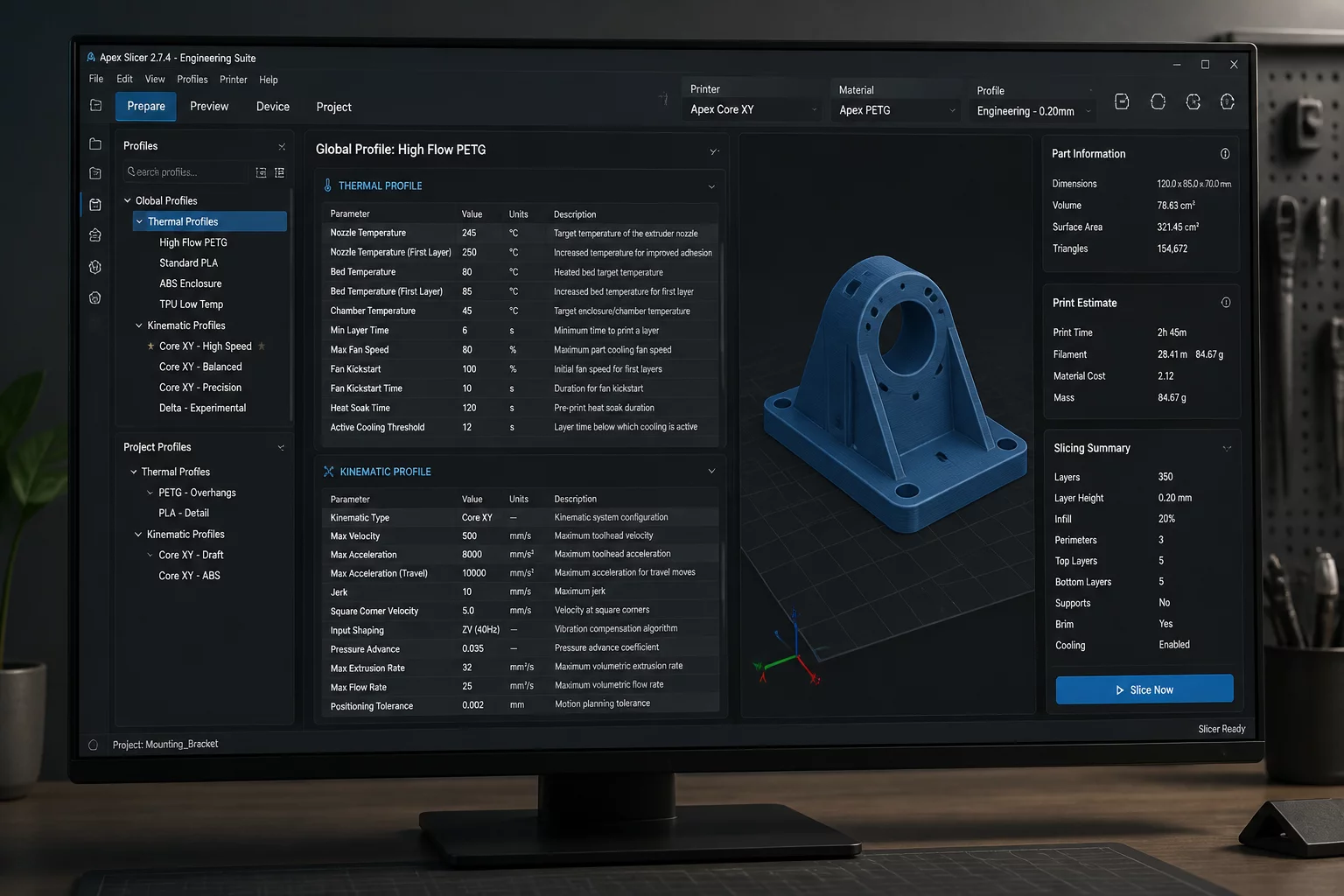
PRESERVING GLOBAL EQUILIBRIUM
Global baseline settings define the thermodynamic, mechanical, and material parameters that govern the physical build plate environment. Local overrides should remain isolated solutions rather than routine workarounds.
Fundamental Criteria for Global Retention
- Extrusion Rheology Balance: Nozzle temperature, heatbed thermal profile, and base volumetric extrusion rates must stay unified to prevent internal stress divergence between concurrent models.
- Motion Kinematics Integrity: Global acceleration, jerk ceilings, and travel move velocities ensure predictable resonance compensation across the entire toolhead trajectory.
- Chamber Thermal Continuity: Cooling fan envelopes and layer time thresholds rely on collective plate exposure rather than disjointed object-level cooling assumptions.
- Production Audit Traceability: Unified profiles prevent hidden variable accumulation that obscures root causes during post-print quality audits and fleet deployments.
ARCHITECTURAL BOUNDARIES OF CONTROL
Before implementing local mesh modifiers or per-object parameter changes, evaluate whether the printing requirement stems from geometry variations or universal physical constraints.
Extrusion temperature and melt-zone residence times are fundamentally governed by filament chemistry rather than individual object geometry. Forcing distinct temperature regimes across items on a single build plate induces severe thermal lag and oozing artifacts during travel transitions.
Slicers process g-code linearly across layer sequences. When thermal targets fluctuate between adjacent parts, the nozzle either over-soaks while waiting or deposits under-plasticized material. Keep these material-driven variables strictly anchored at the global level:
- Hotend primary melt temperature and first-layer thermal offsets.
- Heated bed temperature and ambient enclosure heating targets.
- Filament flow ratio and pressure advance calibration coefficients.
Motion systems operate within structural resonance profiles determined by carriage mass, belt tension, and motor torque curves. Defining extreme acceleration variations between co-located parts leads to inconsistent ringing and frame vibration that degrades surface quality universally.
Global motion limits allow the input shaping algorithm to compensate reliably across the entire g-code program. Overriding acceleration parameters at object level frequently bypasses input shaper optimization, producing visible ghosting along flat surfaces.
- Travel move acceleration limits and non-print rapid transit rates.
- Jerk thresholds and cornering speed damping algorithms.
First layer height, extrusion width, and initial print velocity interact directly with the build plate topography and surface texture. Fragmenting these initial contact rules invites plate-wide leveling inconsistencies and unpredictable warping at component boundaries.
Establishing a single, rigorously calibrated foundation baseline guarantees uniform bed adhesion. If a specific component demands increased holding force, brim geometry should be assigned rather than altering initial extrusion heights globally or locally.
- First layer line width expansion factors and baseline squish.
- Initial layer speed percentages and z-hop clearance heights.
In production environments, slicing profiles serve as version-controlled engineering assets. When operators introduce sporadic local overrides to cure minor surface flaws, the underlying global profile drifts out of alignment with actual fabrication conditions.
Keeping the baseline global forces engineers to solve fundamental process defects at their root cause. When adjustments are proven necessary across repeated batches, updating the master preset preserves full organizational traceability and cross-machine reliability.
- Master profile revision logs and configuration export integrity.
- Repeatable manufacturing outcomes across multi-printer production fleets.