ISOLATING DEMANDING SUBCOMPONENTS FROM BASELINE
When a tiny latch, decorative clip, or thin threaded pin requires extreme perimeters or slow feed rates, applying those adjustments globally degrades total print throughput and structural integrity across unaffected components.
Core Operational Principles
- Root Integrity: Keep default volumetric flow, layer height, and infill percentages intact at the global plate tier to avoid ballooning job times.
- Overhang Containment: Sub-millimeter features often demand slower external wall speeds; assign these strictly at the object or modifier level.
- Thermal Discipline: Tiny geometries overheat quickly without adequate cooling, but forcing global minimum layer times penalizes large parts with heat creep.
- Maintenance Clarity: Preserving standard presets ensures future design revisions do not inherit undocumented baseline mutations.
SYSTEMATIC TECHNIQUES FOR SELECTIVE OVERRIDES
Slicing workflows should quarantine demanding or delicate parts rather than imposing blanket compromises on an entire production run.
Engineers encountering a delicate snap-hook failure often jump straight to increasing global wall counts from three to six or lowering layer heights across the entire project. This reaction solves the local snap tab but doubles machine hours for solid structural housings sharing the bed.
Excess perimeters inside bulk parts trigger internal shrinkage forces, causing unexpected corner lift and dimensional distortion that never existed under factory defaults.
- Massive toolpath overhead on unaffected bulky structures
- Accumulated residual stresses in solid geometric sections
- Erosion of standardized process templates across team archives
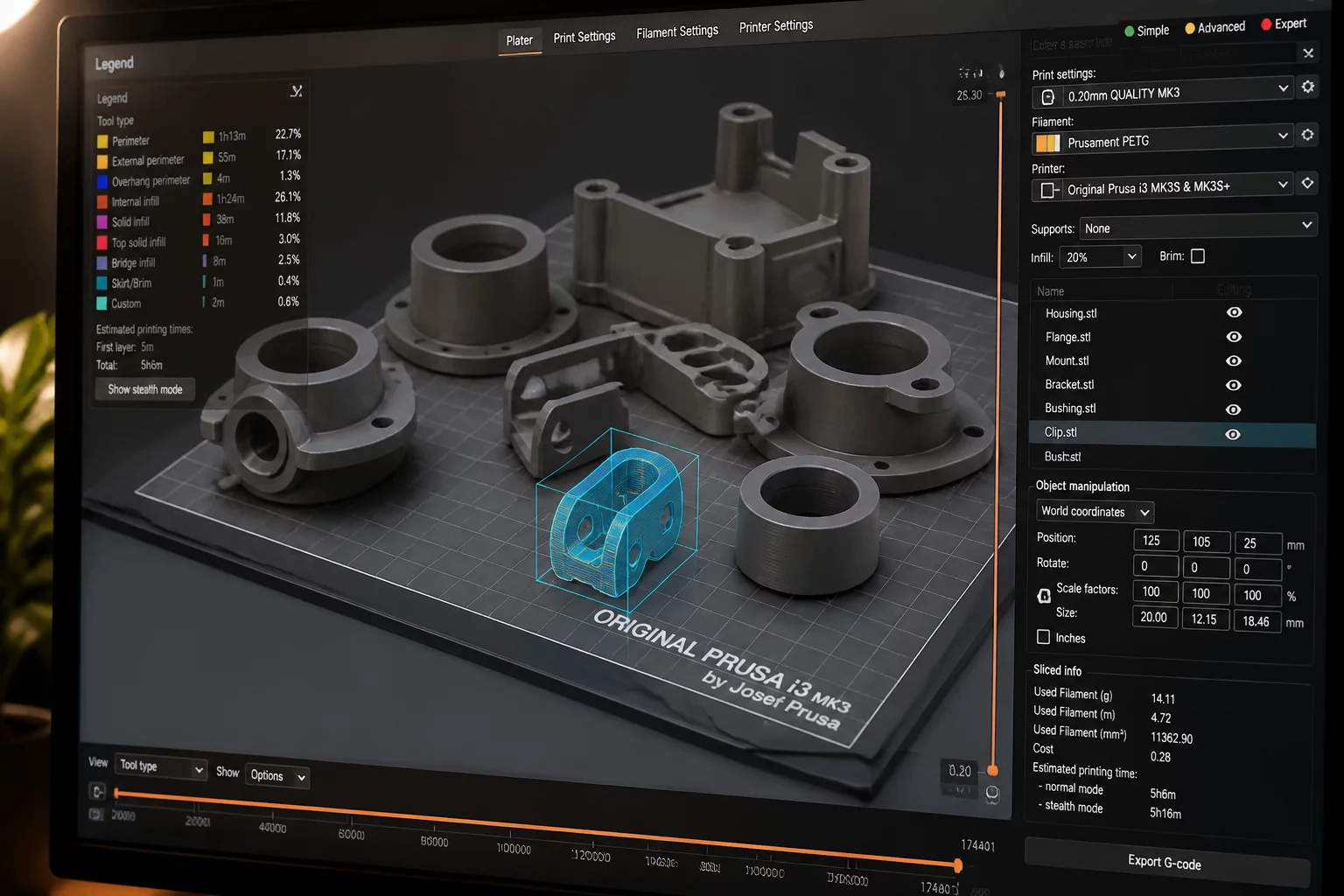
Contemporary slicer engines provide granular object and modifier hierarchies that attach directly to individual geometries. Instead of touching global defaults, right-click the specific model node to inject custom overrides exclusively for that component.
Dense infill, reinforced shell counts, and slow perimeter passes can reside exclusively within high-stress contact surfaces while adjacent housings run at validated throughput rates.
- Perimeter loops increased to five strictly on mechanical retention features
- Localized speed deceleration on delicate threads without slowing broad exterior perimeters
Fine spires or miniature pins frequently sag because deposited polymer cannot cool before the nozzle returns. Modifying minimum layer times globally forces the nozzle to pause or slow to a crawl on every single part, creating surface oozing and stringing artifacts across large exterior faces.
Introducing sacrificial cooling towers or implementing object-level fan boosts resolves thermal stabilization without enforcing universal speed penalties.
- Localized auxiliary fan thresholds targeting fragile vertical columns
- Sequential printing scheduling when bed clearances and gantry paths allow
Shared project bundles deteriorate quickly when engineering teams conceal one-off tweaks inside root profiles. When teammates load an altered base configuration months later, they unknowingly produce out-of-spec batches for subsequent assemblies.
Anchoring custom tweaks directly to object nodes inside the 3MF package ensures that when global profiles receive resin-lot calibrations, project-level logic remains intact.
- Elimination of configuration drift between enterprise material libraries and part builds
- Full inspection transparency across individual entries in the slicer object tree