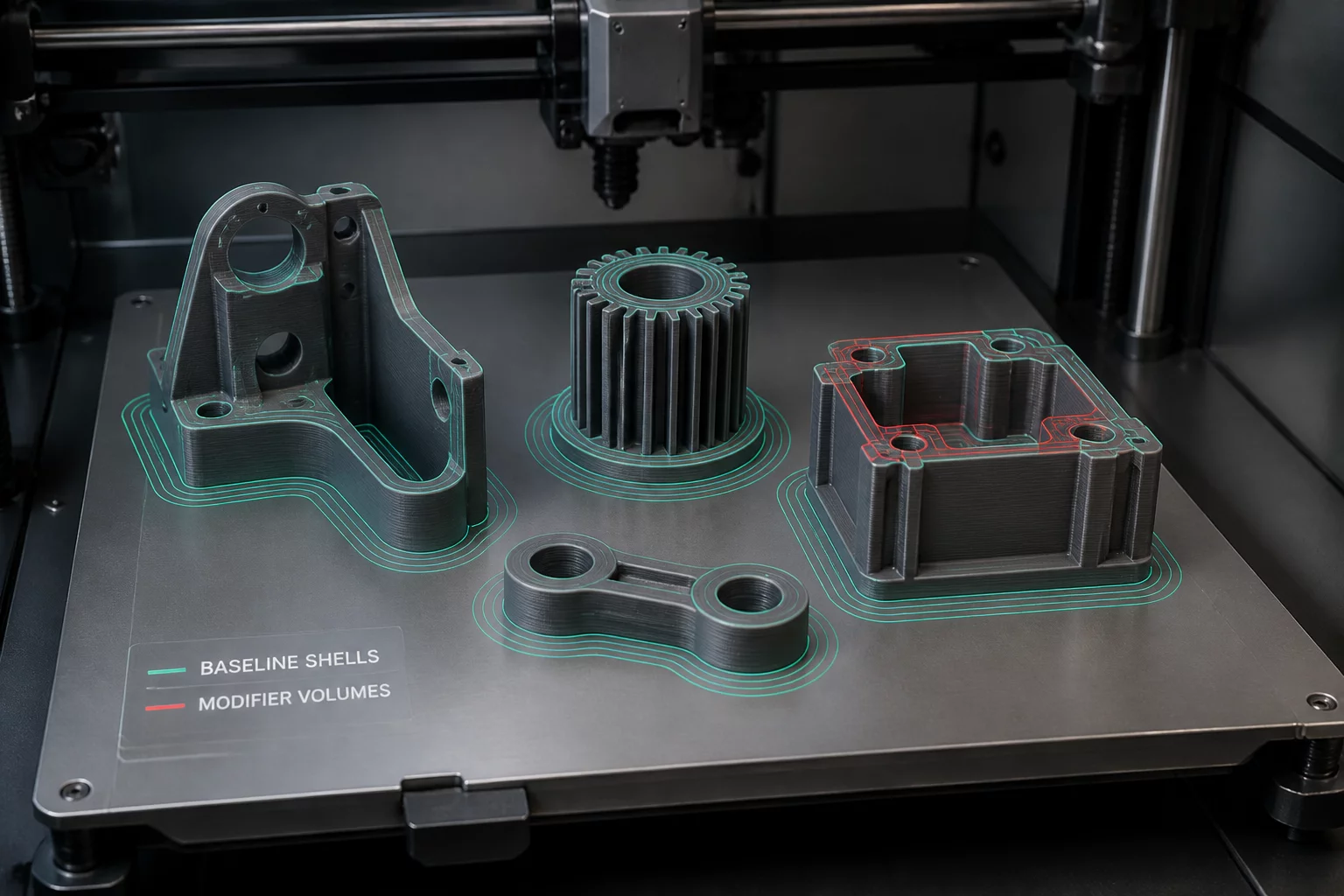
DEFINING THE BOUNDARY BETWEEN BASELINE AND OVERRIDE
A frequent point of failure in additive manufacturing operations is letting a temporary geometry defect corrupt an entire calibrated profile. Choosing between a global baseline mutation and a localized exception dictates whether your future print projects inherit stable defaults or unintended compromises.
Core Evaluation Criteria for Parameter Elevation
- Hardware-Material Coherence: If the underlying issue stems from nozzle mechanics, heater block thermals, or filament melt behavior across all toolpaths, solve it globally at the profile baseline.
- Geometric Isolation: Overhang curling, thin feature collapse, or localized seam weakness on an individual part represent isolated geometric liabilities that belong solely in local modifier scopes.
- Propagation Blast Radius: Shifting global wall counts or perimeter speeds penalizes every unaffected model on multi-part plates, bloating cycle times and altering mechanical baselines unnecessarily.
- Versioning Maintainability: Slicers save local exceptions inside the project container, preserving the pristine global profile untouched for clean version control across production batches.
FOUR TESTS FOR SETTING SCOPE DEMARCATION
Review these four engineering checks before committing changes to your parent slicing preset or applying an object-level modifier mesh.
Start by probing whether every component manufactured under this profile demands the proposed adjustment. If a structural bracket requires five perimeter shells to prevent bolt hole tear-out, elevating global wall count forces decorative enclosures and lightweight ducting on the same plate to carry identical bulk.
Elevate to global only when the parameter represents a universal physical truth for the chosen filament and nozzle pairing.
- Universal volumetric extrusion flow ceilings for high-speed motion
- Linear advance and pressure advance compensation values
- Retraction distance and z-hop parameters calibrated to prevent nozzle oozing
A global shift reshapes toolpaths across every single object residing on the build platform. Slowing down external perimeters to resolve curling on one delicate organic cantilever will inadvertently triple the print duration of three rectangular mounting fixtures sharing the build plate.
Contain acute thermal and speed adjustments to the specific object or local height range modifier.
- Local layer cooling fan overrides for aggressive cantilever sections
- Selective per-object speed throttling during critical bridge overhangs
Consider whether the component is an ephemeral single-run prototype or an enduring production component. When developing a repeat product revision, baking local overrides directly into part geometry modifiers within a saved project container ensures predictable manufacturing repeats.
Global presets evolve over time as slicer versions update; per-part overrides safely survive baseline engine upgrades without losing their tuned geometric tolerances.
- Thread tolerance offsets preserved inside per-part hole horizontal expansion
- Bearing pocket reinforcement contained within local cylinder modifier volumes
The most insidious defect in additive operations is profile drift: an engineer tweaks cooling, infill overlap, or perimeter sequence to fix an urgent defect, saves the preset globally, and accidentally degrades twenty unrelated jobs scheduled for subsequent production.
Treat the global preset as an immutable production baseline requiring rigorous justification before modification.
- Implement strict change notes before updating any master profile
- Enforce local overrides as the default triage mechanism for single-model defects