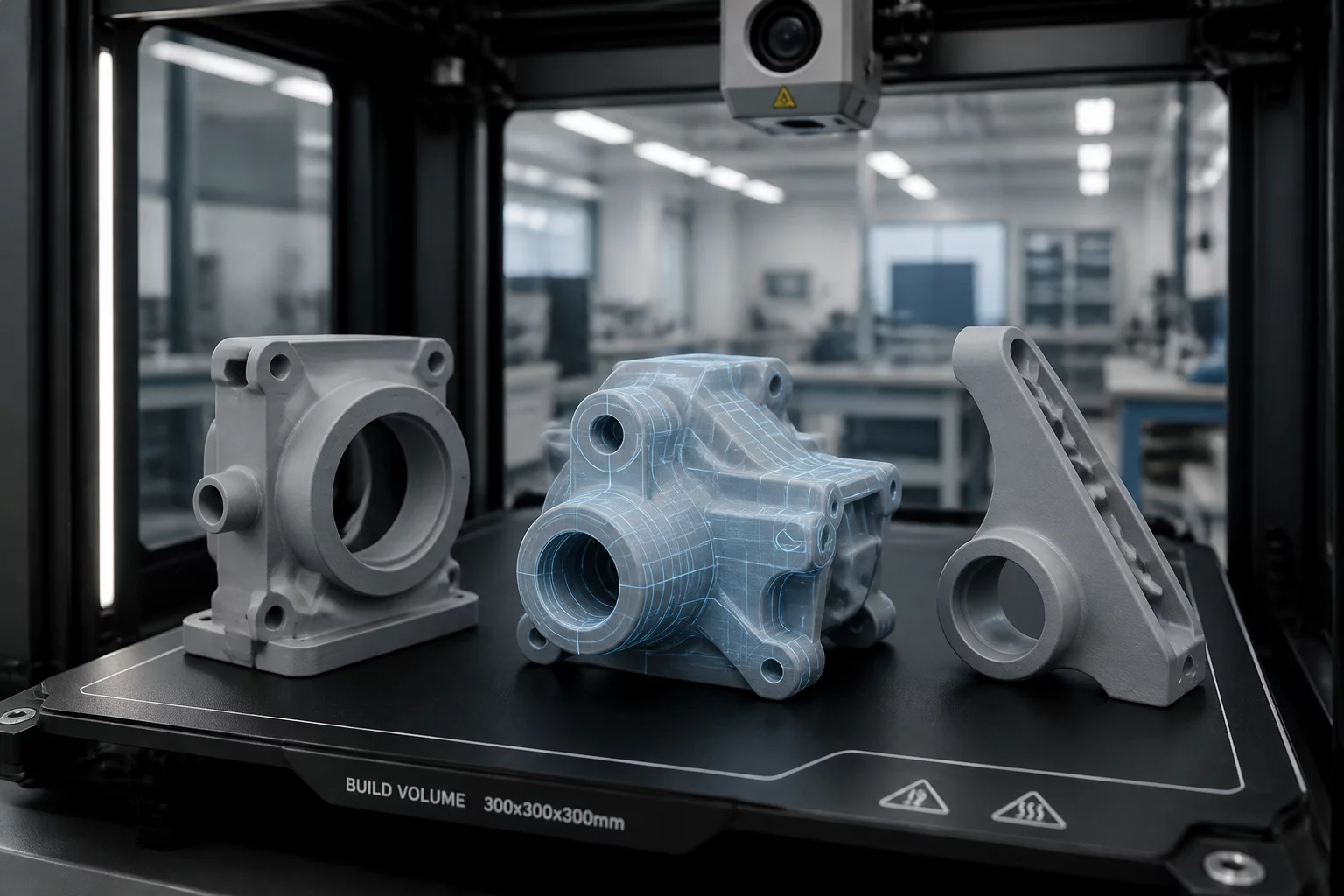
ISOLATING PARAMETERS WITHOUT CORRUPTING PLATE BASELINES
In multi-part manufacturing setups, technicians often encounter one part with demanding geometry that fails under standard production speeds or sparse infill. Adjusting the entire plate configuration to accommodate that single outlier introduces massive print time penalties and unnecessary material consumption across all adjacent models.
Core Principles of Object-Level Differentiation
- Inheritance Isolation: Object-level parameters supersede global plate baselines only within the selected bounding box, preserving universal cooling and movement envelopes elsewhere.
- G-code Predictability: Confining modifications to individual models prevents unintended acceleration cascades and flow variations across stable neighboring parts.
- Material Conservation: Increasing wall loops or infill percentage on a single structural bracket saves up to 40% filament compared to an indiscriminate global plate overhaul.
- Audit Transparency: Modern slicer trees clearly differentiate inherited values from local overrides, enabling precise peer review before dispatching jobs to production.
SURGICAL OVERRIDES IN PRODUCTION ENVIRONMENTS
Applying granular control requires understanding the strict boundary between global project presets and individual object properties in modern slicing pipelines.
Modern slicers such as Bambu Studio and OrcaSlicer organize parameters into a hierarchical cascade. At the project summit sits the global profile, governing defaults for print speeds, wall counts, layer heights, and thermal targets. Whenever an operator modifies an option in the global panel, every entity on the build plate inherits that change.
Switching the slicer view from Global to Objects exposes discrete parameter sets for each mesh. When an override is defined on this object layer, the engine tags that specific attribute as detached from global inheritance, creating a localized envelope that leaves all parallel components untouched.
- Preserves global kinematic boundaries like maximum volumetric speed across uncomplicated components.
- Restricts aggressive wall loop counts exclusively to load-bearing parts.
- Eliminates global cycle-time ballooning caused by singular complex geometries.
Cantilevered features on one component frequently provoke operators to turn on automatic supports globally. This single switch litters every neighboring part with support structures, risking cosmetic blemishes and requiring extensive manual clean-up on parts that never required scaffolding.
By selecting the troublesome entity in the object hierarchy and activating supports only within its individual parameters, adjacent planar parts remain pristine and print at baseline cycle speeds.
- Saves secondary finishing labor by isolating interface layer contact surfaces.
- Reduces support purge and material wastage by up to 70% per batch.
Delicate vertical spires or acute overhangs require extended layer times and reduced nozzle travel speeds to allow adequate molten polymer solidification. Slowing down the entire print bed penalizes large, blocky geometries that would otherwise benefit from high-speed traversal.
Assigning independent outer wall velocities or customized fan thresholds to the sensitive model maintains thermal equilibrium locally without stalling throughput across the remainder of the build volume.
- Improves dimensional precision on thin-walled sections without throttling large solid structures.
- Prevents heat accumulation in small cross-sections through targeted layer dwell timing.
While object overrides provide surgical control, uncatalogued exceptions complicate long-term revision management. When project files are shared across engineering teams, an untracked local override can lead to confusion if design iterations replace the underlying geometry.
Establish clear naming conventions in the slicer object list, and reserve object-level overrides for deliberate functional divergence rather than quick fixes for flawed source CAD.
- Document non-default object properties in production routing sheets.
- Verify individual object layer slices in preview mode before committing G-code to machine queues.