RESOLVING BATCH CONFLICTS ON SHARED PLATES
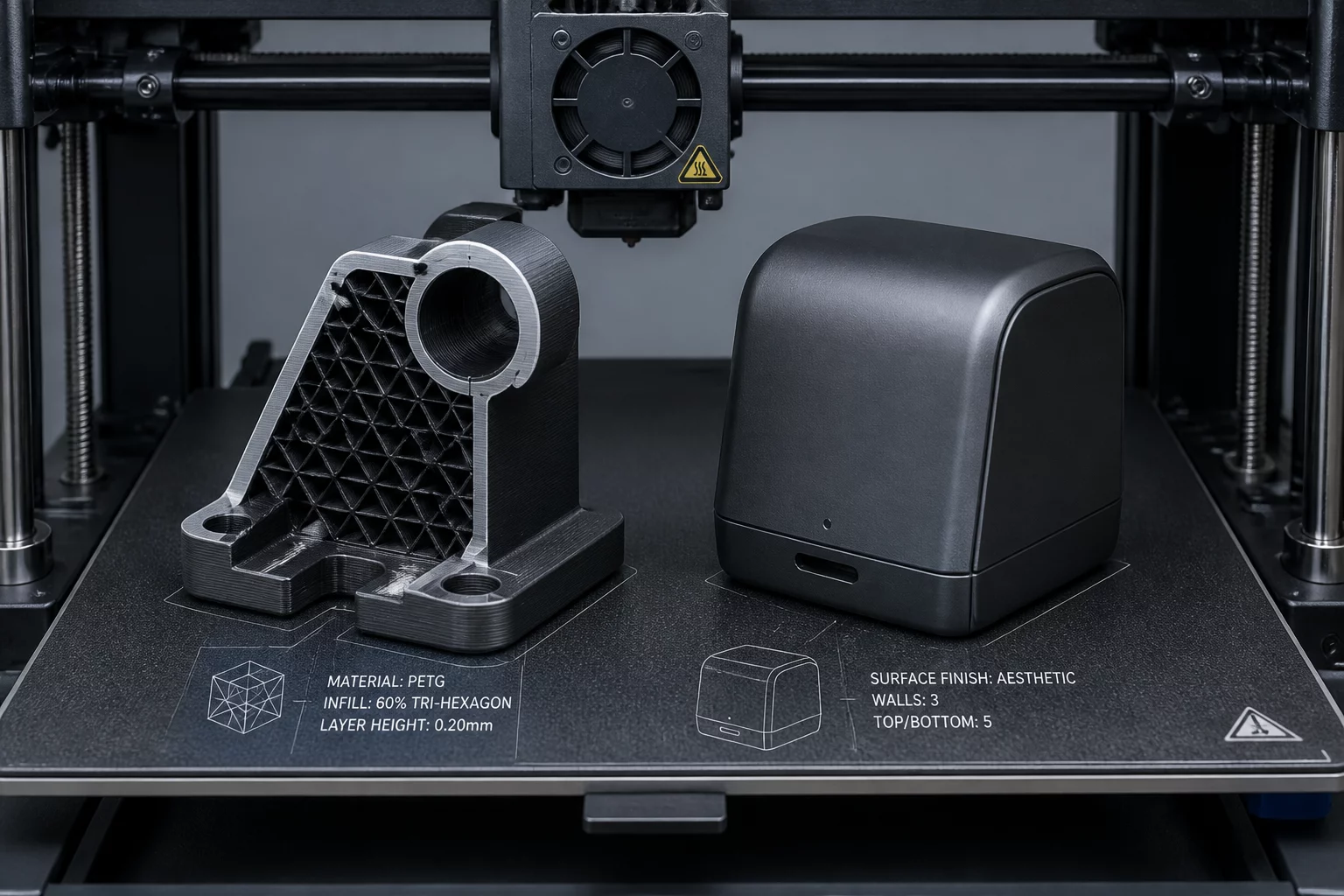
Batching multiple components into a single print job saves operational overhead, but pairing a thin cosmetic housing with a heavy structural bracket often creates a slicer dilemma. Applying global tweaks ruins one part to satisfy the other.
Core Architectural Takeaways
- Independent Shell Counts: Wall thickness and perimeter generation can be decoupled per object to ensure load-bearing parts get 5 perimeters while decorative parts stay lean at 2.
- Thermal & Cooling Divergence: Minimum layer time thresholds and auxiliary fan behavior need discrete monitoring to prevent brittle crystallization on thick cross-sections while preserving overhang detail on smaller mates.
- Variable Layer Heights: Adaptive layer heights can be toggled exclusively for the component possessing shallow slopes, leaving the stepped vertical housing on uniform 0.20 mm steps.
- Travel & Retraction Routing: Sharing a plate forces the nozzle to traverse open gaps between disparate geometries, mandating stringing control without penalizing the global volumetric flow limit.
DECISION MATRIX FOR OBJECT ISOLATION
To keep project files maintainable, engineers must delineate which variables belong in the global machine preset and which belong directly on the individual object node.
When technicians discover that Object A suffers from weak layer bonding while Object B exhibits surface blobs, the intuitive temptation is often to split the difference. Operators slow outer perimeters moderately and increase flow rates universally.
This compromise degrades both parts. Object A remains sub-optimally reinforced, and Object B loses dimensional tolerance around exterior mounting bosses. Averaging global settings is an anti-pattern that conceals opposing mechanical constraints.
- Compromising print speed inflates total plate cycle time unnecessarily for non-critical geometries.
- Global infill density increases add unnecessary weight and filament cost to benign decorative enclosures.
- Uniform cooling rates risk warping structural bases while simultaneously overheating delicate overhang ribs.
Modern slicer engines allow direct selection of any 3D asset in the scene tree to switch parameter context from Global to Objects. Once placed in Object scope, perimeter count, infill percentage, and seam placement become dedicated attributes.
By retaining standard machine baselines at the project root, updates to filament temperatures or retraction speeds automatically cascade to both components without erasing object-specific wall counts.
- Right-click the structural body in the tree view to add distinct perimeters and infill density rules.
- Keep filament profiles synchronized at the plate level to prevent extrusion temperature discrepancies.
Sharing a build plate naturally introduces extended travel movements across the bed. When one part requires high-temperature extrusion for layer adhesion, oozing along travel paths between the two parts threatens the cosmetic finish of the second part.
Setting wipe distance and enabling 'avoid crossing perimeters' at the object level ensures nozzle travel loops remain contained inside the respective perimeter boundaries rather than dragging filament tails across empty build plate space.
- Activate retract on wipe only within the cosmetic geometry's localized quality settings.
- Arrange part footprints along the X/Y axes to minimize long diagonal air moves between perimeter boundaries.
While object-level overrides resolve most geometrical and density divergences, thermal incompatibility cannot be circumvented on a shared plate. If one part demands a 100°C chamber environment for warp prevention while the other requires high fan drafts for tiny overhangs, co-location is physically compromised.
Recognizing when two needs are fundamentally irreconcilable prevents wasted machine cycles. In such events, plate segregation or sequential printing mode remains the proper engineering remedy.
- Segregate parts if minimum layer time cooling requirements cause thermal stress and delamination in adjacent thick-walled bodies.
- Use multi-plate project containers to preserve individual print parameters without forcing simultaneous co-extrusion.