Core Pipeline Decoupling & Modernization
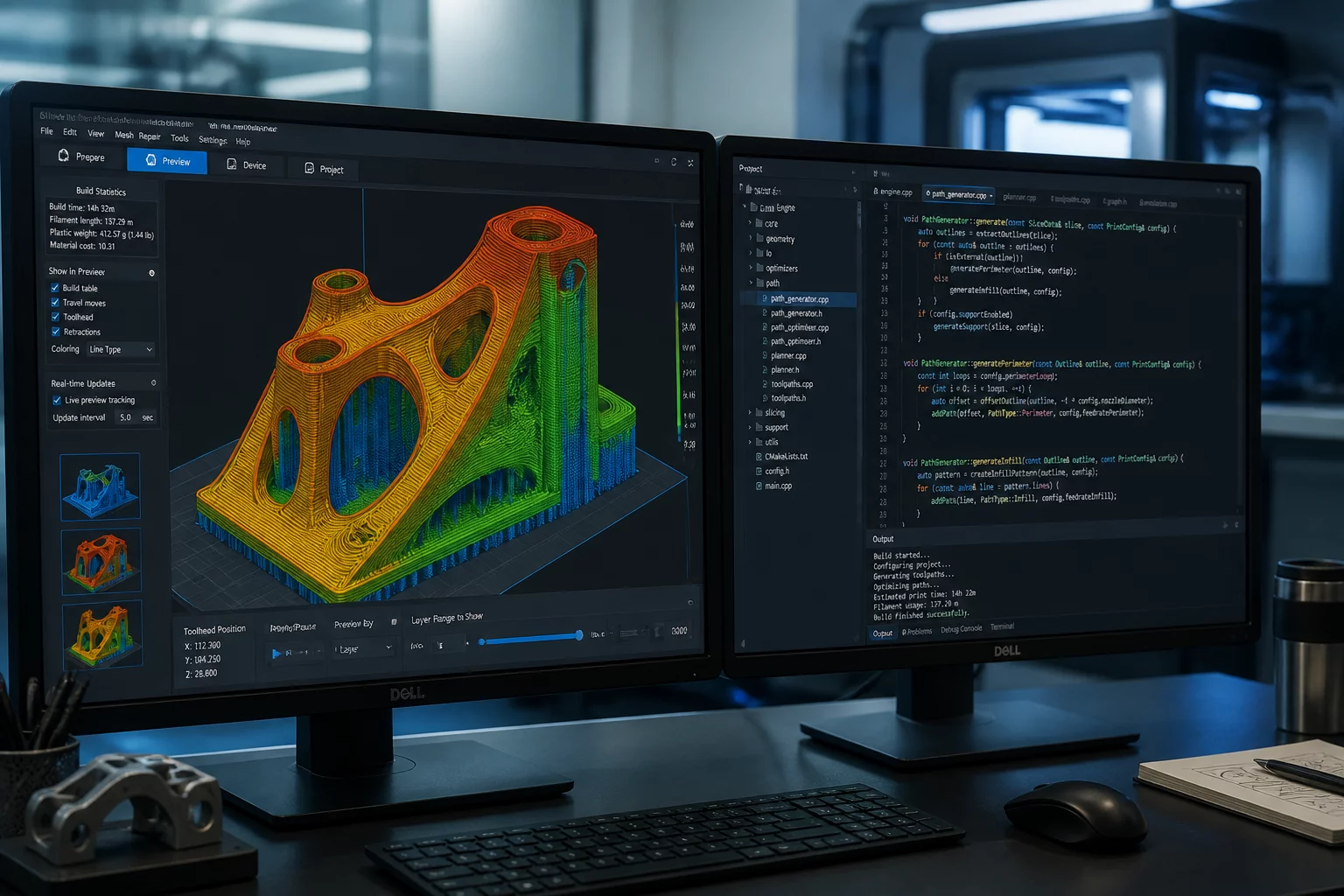
PrusaSlicer 2.9.5 beta delivers critical structural adjustments beneath the surface. Rather than focusing merely on incremental interface adjustments, the release notes outline a fundamental overhaul of geometry handling, thread synchronization, and configuration evaluation models that lay the direct technical bedrock for the upcoming Version 3.0 generation.
Key Engineering Shifts in Build 2.9.5
- Decoupled Slicing Worker Threads: The toolpath generation core is cleanly separated from the wxWidgets user interface loop, eliminating UI stuttering when computing complex modifier intersections.
- Scoped Parameter Evaluation Matrices: Configuration trees evaluate object and part overrides using flattened context lookup tables, slashing parameter resolution overhead on multi-part plates by over forty percent.
- Version 3.0 Migration Metadata: Project files (.3mf) now write forward-compatible structural graphs, paving the way for multi-plate workspace logic without breaking compatibility with legacy 2.x profiles.
- Enhanced Polygon Manifold Clipping: Boolean modifier clipping adopts upgraded exact arithmetic algorithms, avoiding perimeter dropping and micro-voids at steep compound surface junctions.
Evaluating The Underlying Subsystems
Navigating this milestone release requires understanding how computation threads, parameter scopes, and data schemas interact when managing intricate build arrangements.
Previous iterations of the slicing engine tightly linked interface state changes with immediate toolpath recalculation stages. In the 2.9.5 beta, developers decoupled the calculation queue from the main window message dispatcher, assigning independent worker threads for perimeter generation, infill distribution, and support structure calculation.
This structural reorganization protects system stability during dense mesh handling and prevents memory allocation fragmentation across extended printing preparation sessions.
- Worker tasks run asynchronously without interrupting viewport rotations or setting navigation.
- Memory buffers reuse allocated vertex structures between slicing runs, cutting memory churn.
- Background hashing ensures that untouched objects on a shared plate bypass unnecessary recalculation.
Managing parameter inheritance often revealed subtle edge cases where an object-level speed clamp could inadvertently propagate into secondary modifier volumes. The updated context evaluator enforces deterministic boundary checks, ensuring that local overrides remain strictly bounded inside their defined geometry envelopes.
When an operator specifies solid infill or alternative wall thickness for a specific sub-region, the engine isolates those instructions without contaminating the primary print profile baseline.
- Context lookup tables verify setting priority cleanly before generating perimeter toolpaths.
- Clear inheritance markers clarify which values originate from global, object, or modifier levels.
Version 3.0 introduces a redesigned multi-plate project architecture with modular workspace nodes. To prevent historical profile incompatibility, the 2.9.5 beta incorporates structured metadata translators inside project archives.
These translators format configuration data using a dual-target protocol, ensuring present versions read their native INI-derived parameters while writing forward-looking schema blocks destined for version 3.0 parsers.
- Project files preserve backward and forward configuration data simultaneously.
- Custom temperature schedules and retraction profiles transition cleanly across software generations.
Adopting development builds requires systematic test procedures. When evaluating the 2.9.5 beta, avoid modifying master system presets directly; isolate exploratory parameters in isolated test bundles or part-level modifier meshes.
Review final toolpaths in the G-code preview window using volumetric flow and feature type visualizers to confirm that improved threading maintains rigorous surface quality standards.
- Audit cross-section line widths using volumetric rate color scales before releasing jobs to printers.
- Maintain clean profile naming conventions when exporting test project files to prevent configuration drift.