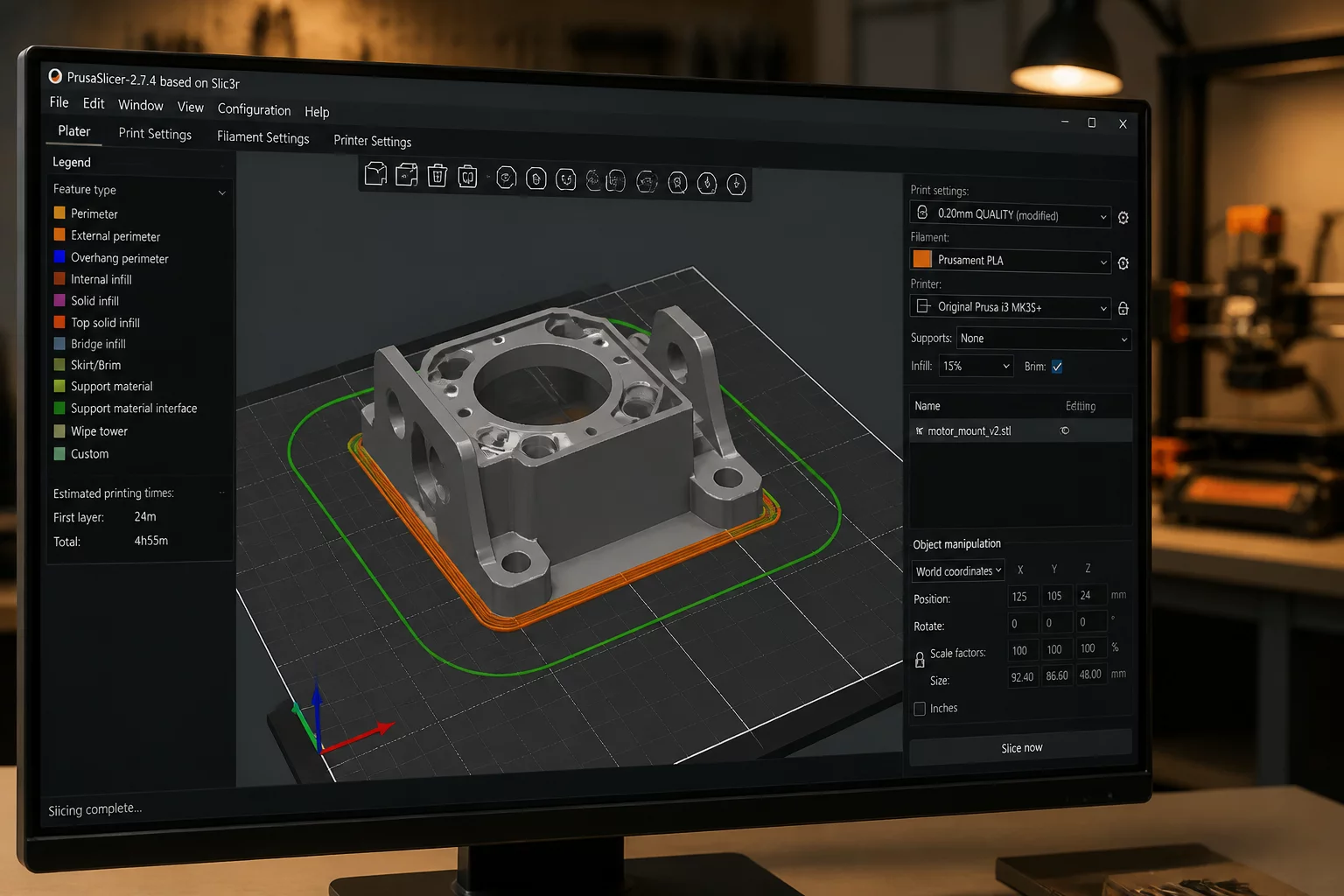
ARCHITECTURAL STABILITY AND TOOLPATH CONTROL
OrcaSlicer v2.4.1 delivers prompt stabilization for production workshops by pairing native ARM64 compilation on Windows with critical corrections to the first-layer perimeter offsetting routine.
Key Engineering Takeaways
- Native Windows ARM64 Architecture: A dedicated compiled package allows Snapdragon X Elite systems to calculate toolpaths without performance overhead from x86 binary translation.
- Clipper Offset Rectification: The polygon offsetting loop no longer forces brim lines into adjacent tree support bases or secondary model boundaries.
- Per-Object Brim Scope Retention: Local brim exclusions and width overrides remain persistently applied across individual objects during multi-bed project navigation.
- Batch Toolpath Generation: Memory leaks during heavy multi-plate slicing jobs have been plugged, stabilizing memory consumption throughout prolonged print dispatch queues.
INVESTIGATING UNDERLYING SLICER FIXES
Examine how these targeted fixes prevent print bed failures, optimize processor cycles, and maintain reliable adhesion hierarchy.
Engineers deploying compact workstations frequently encountered CPU thermal spikes and viewport lag when running x86 builds under Windows Prism emulation. OrcaSlicer v2.4.1 rectifies this bottleneck by introducing an official target compiled directly for ARM64 instruction sets.
Real-world testing exhibits immediate reductions in toolpath calculation times, especially on dense organic geometries and multi-part manufacturing arrangements.
- Eliminates JIT translation overhead during complex CSG mesh boolean calculations.
- Lowers thermal throttling on ultra-slim engineering notebooks during continuous job queuing.
- Provides feature parity with x86_64 distributions without compromising OpenGL render speed.
The previous minor release introduced an unexpected coordinate rounding error inside the skirt and brim perimeter generator. When parts sat in close proximity, brim perimeters overlapped neighboring support contacts and produced unremovable welded perimeter ribbons.
Version 2.4.1 restores the mathematical offset safeguards, separating distinct clearance zones even when aggressive bed adhesion strategies are requested.
- Re-establishes explicit clearance thresholds between support roots and primary object brims.
- Prevents auxiliary skirt loops from merging into multi-material purge towers.
A notable workflow frustration in modern additive workflows occurs when object-level modifiers silently revert back to global bed defaults. This regression affected multi-plate projects whenever users toggled between active build volumes.
The internal configuration parser now accurately tracks object-scoped properties through every plate transition, securing user-assigned brim widths and skirt distances.
- Local brim overrides persist through project save and reload cycles without data corruption.
- Enables reliable unattended batch slicing across heterogeneous plate assemblies.
Adopting v2.4.1 does not require regenerating existing machine or filament configurations. However, production technicians should review project templates that incorporate tight object clearances or localized support blockers.
Validating first-layer toolpath simulations before dispatch ensures that restored clearance margins function as intended across all build surfaces.
- Inspect sliced first-layer preview layers for proper gap separation prior to printing.
- Confirm Windows ARM64 installation package validity when updating enterprise terminal images.