THERMAL PROFILES AND LIGHTNING BRANCHING INFILL
Large structural geometries frequently face excessive build durations and internal heat accumulation when slicing with traditional cubic or gyroid infills. UltiMaker Cura 5.13.0 introduces refined temperature control regimes paired with optimized lightning infill trees, decoupling structural top-skin support from internal mass volume.
Verified Project Parameters & Experimental Outcomes
- Material & Hotend Configuration: Tough PLA on a 0.4 mm AA print core operating with dual thermal zones at 210 °C extrusion baseline and 185 °C standby idle.
- Infill Density & Volume Savings: 22% lightning infill replaced 15% grid pattern, reducing total material usage by 41% and lowering print duration by 5.4 hours across a 240 mm tall architectural form.
- Temperature Ramp Recovery: Nozzle preheat time window calibrated to 14 seconds prior to prime tower engagement, eliminating cold-extrusion under-extrusion on perimeter re-entry.
- Surface Top-Skin Deflection: Measured downward sag remained under 0.08 mm on unsupported spans up to 35 mm, supported by adaptive internal branching forks directly beneath top layers.
CURA 5.13.0 WORKFLOW ARCHITECTURE
A systematic walkthrough of hotend temperature regime calibration, standby thermal stability, lightning tree generation logic, and print-bed heat bed dissipation management.
UltiMaker Cura 5.13.0 calculates thermal transition curves based on volumetric flow and nozzle speed. In high-volume aesthetic prints, fluctuating extrusion rates can cause uneven melting zones if temperature remains completely static across variable speeds.
Adjusting the printing temperature initial layer, flow-compensated temperature offsets, and nozzle expansion compensation prevents initial thermal shock and maintains consistent viscosity throughout outer surface wall travel.
- Set initial layer printing temperature 5 °C above nominal print temperature to maximize bed bonding without bubbling.
- Enable flow-dependent temperature compensation to raise heat during rapid infill passes and drop back down on delicate outer perimeters.
- Verify standby temperature limits to prevent polymer carbonization inside the melt chamber during extended travel or dual-core waiting phases.
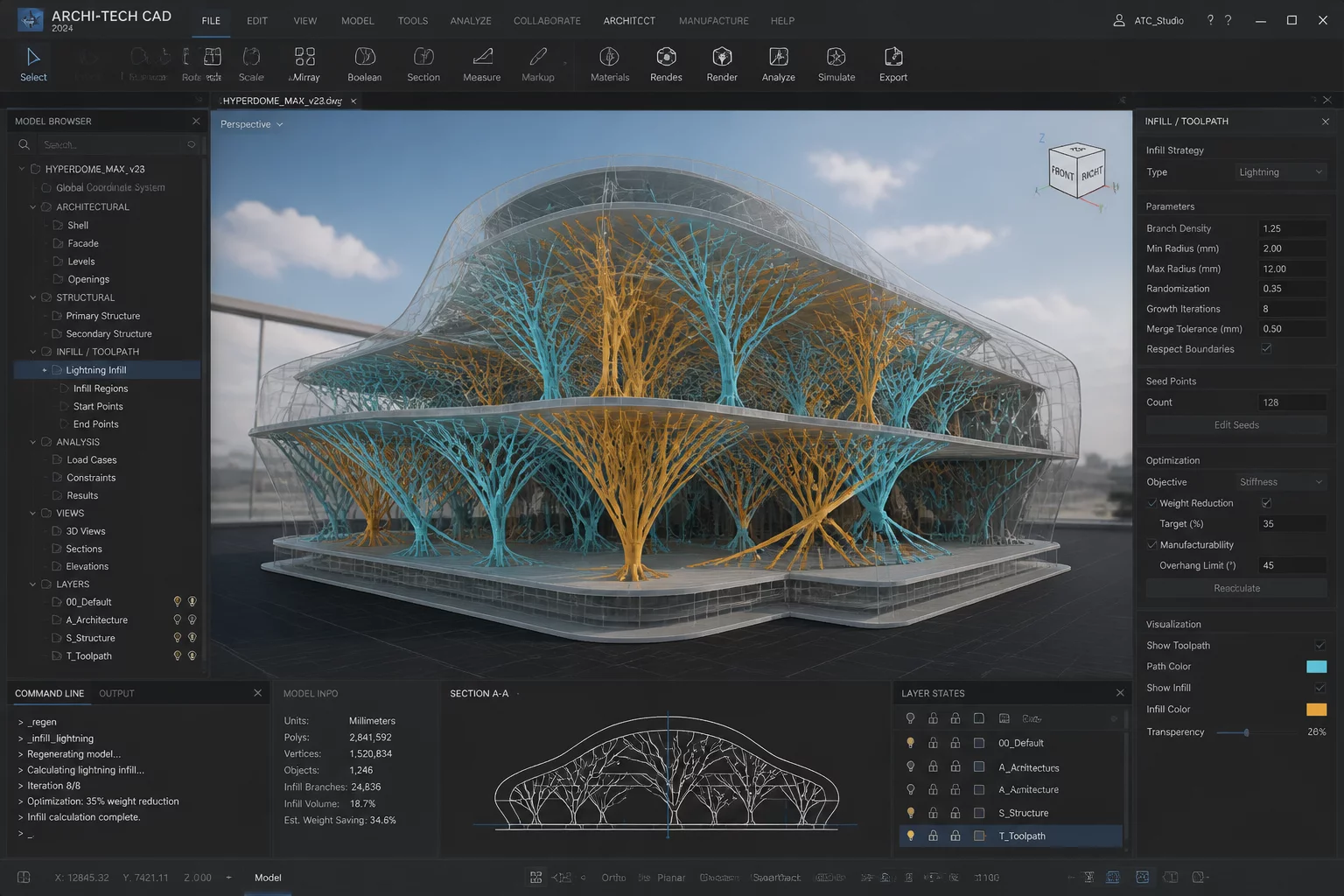
Unlike uniform grid, gyroid, or honeycomb matrices that generate continuous internal scaffolds from the build plate upward, Cura's lightning infill builds inverted tree-like branches anchored only to sidewalls and ceilings where downward roof loads occur.
Calibrating the infill overhang angle and pruning threshold ensures branches originate high on the sidewalls rather than wasting material near the base of hollow cavities.
- Calibrate lightning infill overhang angle between 45° and 52° to avoid branch collapse during free-floating cantilever deposits.
- Configure lightning branch pruning threshold to eliminate extraneous micro-spikes that fail to connect to top skin polygons.
During multi-core jobs or extended lightning travel hops, the print core spends prolonged periods moving across empty air without depositing material. If held at full extrusion temperature, gravity causes plastic droop and nozzle oozing that mar exterior surfaces.
Activating nozzle temperature drop during idle intervals alongside prime tower wipe commands ensures thermal stability while preventing stringing defects.
- Establish an active standby delta of 25 °C to drop the core below glass transition during long travel cycles.
- Sync core preheating lead time with axis travel acceleration to restore flow dynamics before the perimeter seam initiates.
Inspecting the layer-by-layer preview in Cura 5.13.0 confirms that top solid skins do not collapse between lightning branch nodes. Because the model interior is mostly hollow, skin thickness and extra skin layers must compensate for wide nodal intervals.
Applying four solid top layers with monotonic top/bottom order ensures complete bridging over lightning fork tips without pillowing or visible surface voids.
- Implement at least 4 top solid layers (0.8 mm minimum at 0.2 mm layer height) to ensure airtight bridging across branch spans.
- Review G-code flow rate visualization in the Cura 5.13.0 preview mode to verify steady volumetric feed at branch-to-skin transitions.