CALIBRATING NESTED HIERARCHIES ON COMPLEX ASSEMBLED PLATES
In multi-component additive runs, applying blanket profile edits creates unnecessary material consumption and compromises dimensional precision. This practicum project breaks down how to orchestrate Bambu Studio parameter inheritance from global build plate defaults down to discreet geometric modifiers.
Hierarchical Architecture Benchmarks
- Root Inheritance Layer: Global printer and filament presets dictate baseline acceleration, volumetric flow constraints, and layer temperature regimes across the entire build envelope.
- Object Override Scope: Mechanical load-bearing housings receive individual outer wall count increases and infill pattern changes without altering adjacent low-stress decorative bezels.
- Modifier Volume Precision: Localized cylindrical mesh modifiers enforce solid 100% infill zones solely around threaded heat-set inserts to resist pull-out torque.
- Execution Verification: Layer-by-layer G-code preview audits confirm discrete flow velocity shifts across intersecting boundary meshes before sending jobs to the machine.
FOUR STAGES OF PARAMETER SEGREGATION
Establishing dependable parameter inheritance requires strict operational separation. Follow this sequential protocol to configure multi-tiered print jobs without cross-contaminating global slicer profiles.
The primary build file begins with rigorous baseline selection. Selecting an engineering filament preset locks volumetric extrusion limits, fan cooling curves, and retraction thresholds across the global workspace.
Global settings establish the common denominator for all parts on the plate. Altering global cooling or chamber thermal parameters at this stage protects high-temperature polymers from premature delamination.
- Pinning global layer height to a 0.20 mm standard baseline.
- Defining plate-wide travel speeds and z-hop clearance values.
- Calibrating global pressure advance and maximum volumetric flow caps.
When parts with contrasting structural requirements populate the same build plate, switch from Global mode to Objects mode in the Bambu Studio process tab. This exposes discrete parameter fields for each standalone CAD body.
The structural mounting bracket is set to four outer perimeters with 30% gyroid infill, while neighboring cosmetic covers retain two perimeters and 12% sparse infill, saving 28% print duration overall.
- Customizing wall loops and top shell thickness strictly for load-bearing geometries.
- Preserving baseline speeds on non-critical parts to prevent cycle time ballooning.
For high-stress localized stress concentrations, full-object parameter density is excessive. Right-clicking the target component and selecting Add Modifier introduces parametric geometric volumes directly into the assembly hierarchy.
Positioning cylinder modifiers around fastener through-holes allows localized transition from gyroid to solid concentric infill, concentrating structural mass solely where mechanical tension concentrates.
- Restricting solid infill to the 5 mm boundary around threaded insert pockets.
- Eliminating interface seam scarring by aligning internal modifier transitions.
Critical bearing journals and chamfered overhanging features demand finer vertical resolution without penalizing the overall part cycle. Activating Variable Layer Height or setting discrete height ranges applies sub-0.12 mm slicing to curved contours.
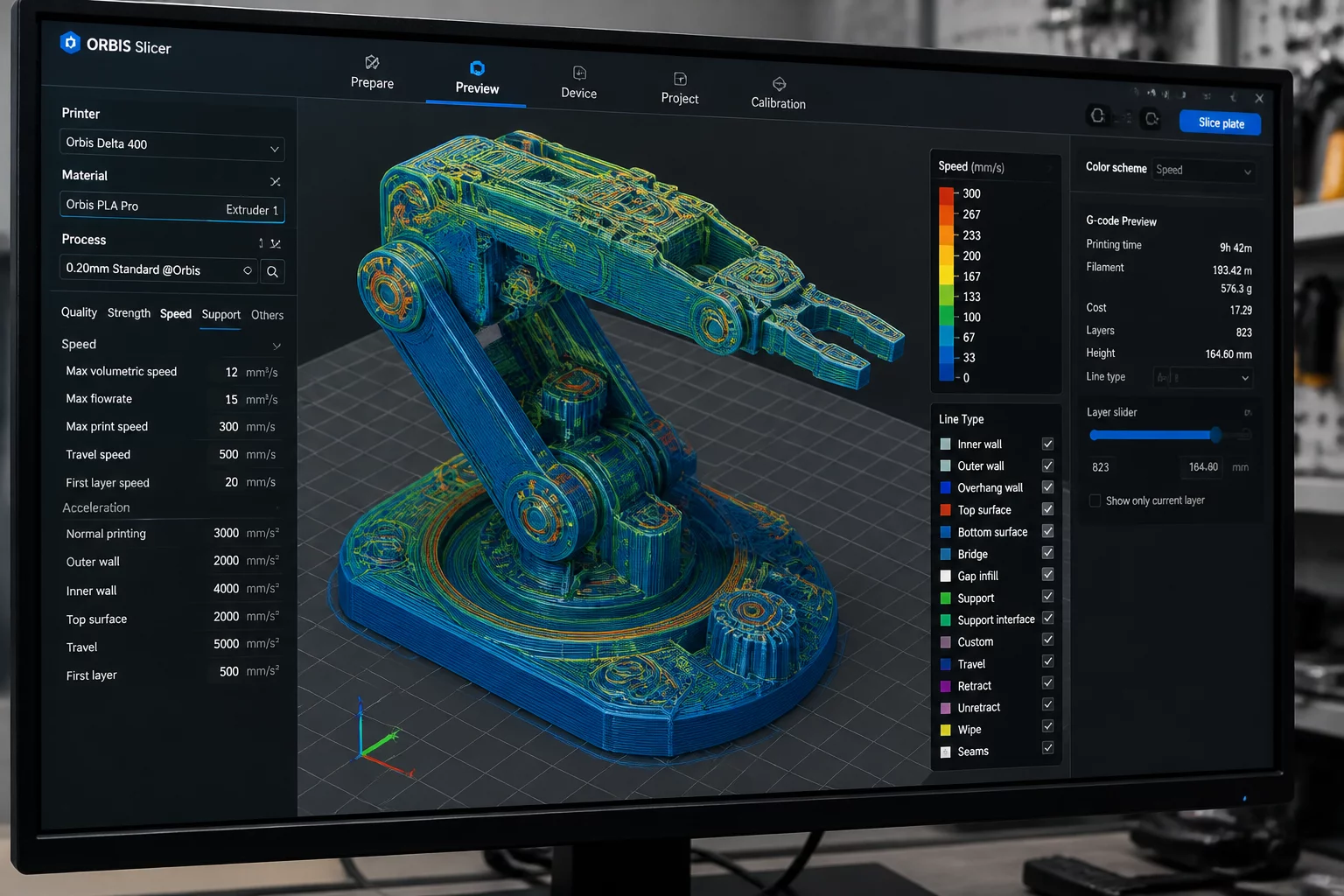
Final inspection in the sliced preview tab toggling Line Type and Speed visualization verifies that nested overrides take precedence over parent baselines exactly as specified.
- Fine-tuning overhang speeds and adaptive layer steps on complex contour bands.
- Performing volumetric flow sanity checks to prevent heat creep in slow zones.